
Generative AI is powerful, but “out of the box” LLMs are just raw potential. Too often they hallucinate, leak data, and can’t execute complex tasks in the real world. To turn GenAI into a production-grade business tool, you need more than prompt engineering; you need rigorous software engineering.
We are a custom Agentic AI development services firm that bridges the gap between AI potential and enterprise reality. We don’t just integrate APIs. We engineer secure, agentic AI systems with controlled autonomy—orchestrating multiple AI agents, grounding them in your private data through custom Retrieval-Augmented Generation (RAG) pipelines, and building the guardrails required for enterprise deployment. We turn passive chatbots into active, secure participants in your business workflow.
We engineer the complex architecture required to deploy autonomous AI and secure Generative AI in the enterprise.

Integrating LLMs into existing workflows requires more than just an API key. We handle the full-stack engineering required to make GenAI reliable and secure within your infrastructure.
Deploying open-source models (like Llama or Mistral) within your own VPC to ensure data never leaves your perimeter.
Building secure, authenticated connectors to your ERP, CRM, and proprietary databases so the AI can act on real-time business data.
Implementing engineering layers to detect hallucinations, filter sensitive data, and ensure compliance before an AI response ever reaches a user.
We move beyond single-prompt interactions to build “Agentic AI” systems capable of planning, executing multi-step tasks, and using tools within defined constraints to achieve a goal.
Engineering agents that can reliably interface with your internal APIs, execute SQL queries, or manipulate software to finish a job.
Implementing architectures (like ReAct or Plan-and-Solve) that allow agents to break down complex user requests into executable steps.
Designing systems where agents handle 90% of the work autonomously but intelligently escalate critical decisions to human operators.
For complex enterprise problems, one AI isn’t enough. We utilize our multi-agent orchestration engineering development services to architect sophisticated systems where specialized AI agents collaborate to solve problems.
Building the control layer that manages communication, hand-offs, and conflict resolution between different specialized agents (e.g., a “researcher” agent passing data to a “coder” agent).
Engineering scalable systems where multiple agents run in parallel to accelerate complex workflows like supply chain optimization or complex software testing.
A model is only as good as its context. Our enterprise RAG pipeline engineering development services securely ground your AI in your proprietary knowledge base, reducing hallucinations through grounding, validation, and guardrails.
Designing scalable vector search infrastructure (using Pinecone, Weaviate, or AWS OpenSearch) optimized for your specific data types.
Going beyond simple semantic search to implement hybrid search, re-ranking algorithms, and metadata filtering to ensure the AI retrieves the exact right context every time.
Building the automated ELT pipelines that ingest, chunk, and embed your unstructured documents (PDFs, wikis, emails) into the RAG system.
We engineer GenAI solutions that solve specific, high-value business problems. View all our AI engineering case studies.

Off-the-shelf models struggle with complex, multi-modal workflows. We provided generative AI integration services for WorkDone to engineer a secure, AWS-powered solution that combines video processing with GenAI reasoning. This integrated architectural approach helped the client cut processing costs by 99%, scale seamlessly, and significantly enhance procurement efficiency.

Off-the-shelf search platforms frequently fail to understand complex user intent. To resolve this for a major retailer, we engineered a custom NLP model and integrated a high-speed vector database (Milvus) to build a proprietary semantic search engine. This architecture understands ambiguous queries, virtually eliminating “null results” and driving a 2.5x increase in digital revenue while securely syncing with 1,000+ distributed endpoints.

Complex AI applications require robust, scalable data orchestration. To resolve on-premise hardware bottlenecks for a leading therapeutic antibody discoverer, we architected a cloud-native data pipeline capable of processing terabytes of high-resolution imagery. By streaming data directly to scalable cloud storage and triggering parallel GPU compute clusters for real-time inference, the engineered solution eliminated latency and increased processing throughput by 10x.
Off-the-shelf models struggle with complex, multi-modal workflows. We provided generative AI integration services for WorkDone to engineer a secure, AWS-powered solution that combines video processing with GenAI reasoning. This integrated architectural approach helped the client cut processing costs by 99%, scale seamlessly, and significantly enhance procurement efficiency.
Off-the-shelf search platforms frequently fail to understand complex user intent. To resolve this for a major retailer, we engineered a custom NLP model and integrated a high-speed vector database (Milvus) to build a proprietary semantic search engine. This architecture understands ambiguous queries, virtually eliminating “null results” and driving a 2.5x increase in digital revenue while securely syncing with 1,000+ distributed endpoints.
Complex AI applications require robust, scalable data orchestration. To resolve on-premise hardware bottlenecks for a leading therapeutic antibody discoverer, we architected a cloud-native data pipeline capable of processing terabytes of high-resolution imagery. By streaming data directly to scalable cloud storage and triggering parallel GPU compute clusters for real-time inference, the engineered solution eliminated latency and increased processing throughput by 10x.
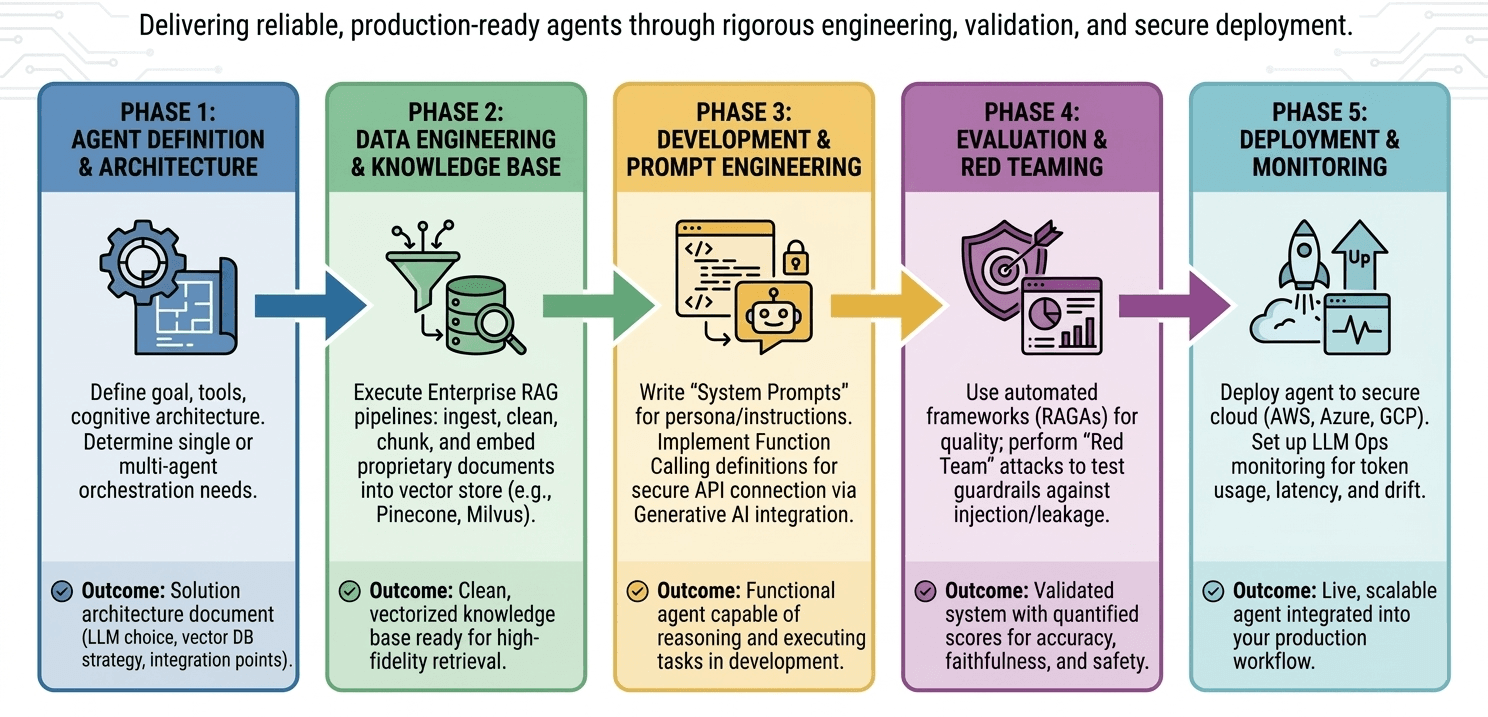
We deliver reliable, production-ready agents by rigorously engineering the data foundation, validating the reasoning architecture, and securing the deployment environment.
We define the agent’s goal, its available tools, and cognitive architecture to determine if a single or multi-agent system is needed. We deliver a solution architecture document defining the LLM choice, vector database strategy, and integration points.
We execute Enterprise RAG pipelines engineering development services to ingest, clean, chunk, and embed your proprietary documents. The result is a clean, vectorized knowledge base ready for high-fidelity retrieval.
We write system prompts and implement function calling definitions to securely connect the agent to your internal APIs. We deliver a functional agent capable of reasoning and executing tasks in a development environment.
We use automated evaluation frameworks and red team attacks to test guardrails against prompt injection or data leakage. This provides a validated system with quantified scores for accuracy, faithfulness, and safety.
We deploy the agent into your secure cloud environment and set up LLMOps monitoring. The final deliverable is a live, scalable agent integrated into your production workflow.
We work with the best-in-class tools for building enterprise AI.




Agentic AI relies on strong data foundations and scalable infrastructure. Explore our related engineering services that support end-to-end AI deployment.
Off-the-shelf tools like Copilot cannot be trusted to execute autonomous tasks on proprietary systems. While ChatGPT is a passive productivity tool, our custom Agentic AI development services allow us to build proactive agents securely connected to your internal APIs, engineered with strict guardrails for automated enterprise operations.
We ensure security by building single-tenant, VPC-enclosed architectures. Unlike SaaS offerings, our enterprise RAG pipelines engineering development services embed and store your data in a private vector database. By utilizing private network endpoints and strict IAM roles, your proprietary data never traverses the public internet or trains a public model.
A chatbot is passive, while an autonomous AI agent is proactive and goal oriented. Through autonomous AI agent development services, we engineer systems that achieve a high-level objective (e.g., “Process this claim”), autonomously plan the steps, utilize external databases to gather data, and execute the workflow without continuous human prompting.
Complex enterprise workflows require specialization for accuracy and reliability. Just as you wouldn’t hire one person for every corporate role, we utilize multi-agent orchestration engineering development services to build systems where distinct agents (e.g., a “planner” and an “executor”) collaborate, drastically improving both performance and auditability.
We typically recommend a hybrid architecture. Large proprietary models excel at complex, generalized reasoning. However, for high-volume, domain-specific tasks, our generative AI integration services fine-tune smaller open-source models to run entirely within your private infrastructure. This reduces inference latency and API token costs while keeping sensitive enterprise data completely offline.
Moving from basic LLMs to autonomous enterprise systems requires strict architectural discipline. Explore our latest technical insights on building secure, production-ready AI. Explore all AI engineering articles.

Integrating LLMs with proprietary databases is the foundation of secure enterprise RAG pipelines engineering. Discover the technical trade-offs, architecture choices, and security guardrails required to harness generative models for production-grade data analysis.

Discover how custom Agentic AI development and connected device engineering combine to create intelligent ecosystems. We discuss the transition from traditional software models to AI-driven architectures that deliver continuous, recurring ROI.

Traditional software engineering paradigms are shifting rapidly as autonomous AI agents enter the enterprise. Learn how technical leaders adapt their architectures, scaling their infrastructure, and managing the disruptive power of Generative AI.
Integrating LLMs with proprietary databases is the foundation of secure enterprise RAG pipelines engineering. Discover the technical trade-offs, architecture choices, and security guardrails required to harness generative models for production-grade data analysis.
Discover how custom Agentic AI development and connected device engineering combine to create intelligent ecosystems. We discuss the transition from traditional software models to AI-driven architectures that deliver continuous, recurring ROI.
Traditional software engineering paradigms are shifting rapidly as autonomous AI agents enter the enterprise. Learn how technical leaders adapt their architectures, scaling their infrastructure, and managing the disruptive power of Generative AI.