 A rapidly expanding retail chain faced a “good problem”: rapid growth. Scaling from four locations to over 1,000 required a fundamental rethink of their supply chain. Legacy manual planning was causing stock-outs of 15-18%, resulting in lost revenue and customer churn.
They partnered with us to engineer a custom AI inventory management solution. Unlike rigid off-the-shelf software, we built a flexible data ecosystem that integrated demand-driven planning with an advanced AI semantic search engine. The initial deployment reduced stock-outs to under 5% and drove a 2.5x increase in online revenue, laying the data foundation for the next phase of autonomous, agentic retail operations.
The Challenge: The Limits of Legacy Systems
As the client aggressively expanded their footprint, their legacy infrastructure became a bottleneck.
- Inventory Mismatch: Without accurate predictive demand forecasting, high-demand items were frequently out of stock (15-18% rate), while slow-moving SKUs gathered dust.
- Search Failure: Their digital platforms used basic text search, which failed to understand user intent or synonyms. Ambiguous queries led to “No Results” pages 10% of the time, killing conversion.
- Siloed Data: Critical supply chain data was trapped in disconnected systems. Manual consolidation was slow and error-prone, making real-time data engineering impossible.
Scaling a nationwide retail network requires more than just logistics; it requires predictive intelligence to see around corners. We didn’t just build a search bar; we engineered a real-time data ecosystem that connects every store’s inventory to the heartbeat of customer demand.
The Engineering Solution: A Data-Driven Retail Ecosystem
We engineered a comprehensive digital ecosystem that connected the supply chain directly to customer demand signals.
Custom Predictive Demand Forecasting
We moved the client from reactive restocking to predictive planning. By analyzing sales data across the expanding store network, we built custom AI models that forecast demand at the individual store level. This system automatically optimizes inventory replenishment, ensuring the right products are in the right locations before customers ask for them.
This custom approach to pharmacy inventory optimization allowed the client to categorize medicines into specialized prediction groups, achieving a 98% forecast accuracy for critical prescription medications.
AI Semantic Search Engine
To fix the digital customer experience, we implemented a specialized AI search engine using ViHealthBERT, a language model fine-tuned for the client’s specific domain. By replacing traditional keyword-based matching with Vector Similarity Search via Milvus, the system understands user intent even when customers use slang, vague descriptions, or misspellings—drastically reducing ‘null result’ rates.
- Intent Detection: The system understands user intent even if they use slang, vague descriptions, or misspellings.
- Entity Recognition: It correctly identifies product names, categories, and attributes from natural language queries, drastically reducing “null result” rates.
Real-Time Customer DNA
We implemented a “Customer DNA” profile system that aggregates real-time data to personalize recommendations. This allows the platform to rank products dynamically based on a user’s specific profile and purchase history, driving cross-selling opportunities.
Custom AI Inventory & Semantic Search Platform
Our custom retail AI architecture utilizes domain-specific NLP (ViHealthBERT) and vector similarity search to virtually eliminate “null results” and optimize inventory flow across 1,000+ locations.

The Results: Healthier Operations, Stronger Revenue
The transformation from manual management to AI-driven supply chain modernization delivered immediate business impact:
- <5% Stock-Out Rate: Down from 18%, ensuring product availability during peak demand.
- 2.5x Online Revenue: The improved search and recommendation engine directly correlated with a significant increase in digital sales.
- 95% Search Accuracy: The semantic search engine virtually eliminated “null results” for valid queries, up from a previous accuracy of only 5-15%.
- Massive Scalability: The custom architecture successfully supported the chain’s expansion to over 1,000 stores without degrading performance.
Next Phase: Orchestrating Autonomous Retail Agents
To further scale the client’s capabilities, we are architecting the next phase of this ecosystem: transitioning from predictive analytics to autonomous retail operations agents. This architecture utilizes a planner-executor pattern to automate complex supply chain and customer service workflows.
- Shopping Assistant Agent: Replacing semantic search with a conversational, multi-turn product discovery agent. Utilizing advanced tool calling, this agent interfaces directly with the inventory database to check real-time stock, suggest viable substitutes, and autonomously reserve items.
- Pharmacy & Ops Copilot: A specialized internal agent utilizing Retrieval-Augmented Generation (RAG) to instantly answer staff queries against internal Standard Operating Procedures (SOPs) and live inventory data.
- Multi-Agent Orchestration: These specialized agents share memory built on the “Customer DNA” profile. Orchestration is managed via APIs and Model Context Protocol (MCP), securely tool-calling into the client’s existing ERP, POS, and WMS systems to execute actions without continuous human intervention.
We utilized a high-performance, scalable stack designed to handle massive concurrent queries and real-time data synchronization.
AI & NLP Models
- ViHealthBERT (Custom Embedding Model), Named Entity Recognition (NER), Intent Detection
- Agent Orchestration: LangChain and Model Context Protocol (MCP) for multi-agent tool calling and ERP/WMS integration.
Vector Database
- Milvus for high-speed vector similarity search.
Search Engine
- Elasticsearch for hybrid keyword/semantic search.
Product Database
- MongoDB for flexible schema management.
Infrastructure
- Hybrid Cloud Architecture with automated Data Sync Up pipelines to ensure real-time inventory synchronization across 1,000+ distributed POS endpoints.
The Engine Behind the Solution
This project was executed by utilizing our expertise in Data Engineering, Cloud Architecture, and Applied AI. We deliver complete, integrated systems built on robust open-source foundations (like Milvus and Elasticsearch), ensuring our clients own their IP and avoid proprietary vendor lock-in”.
Our AI CoE Capabilities
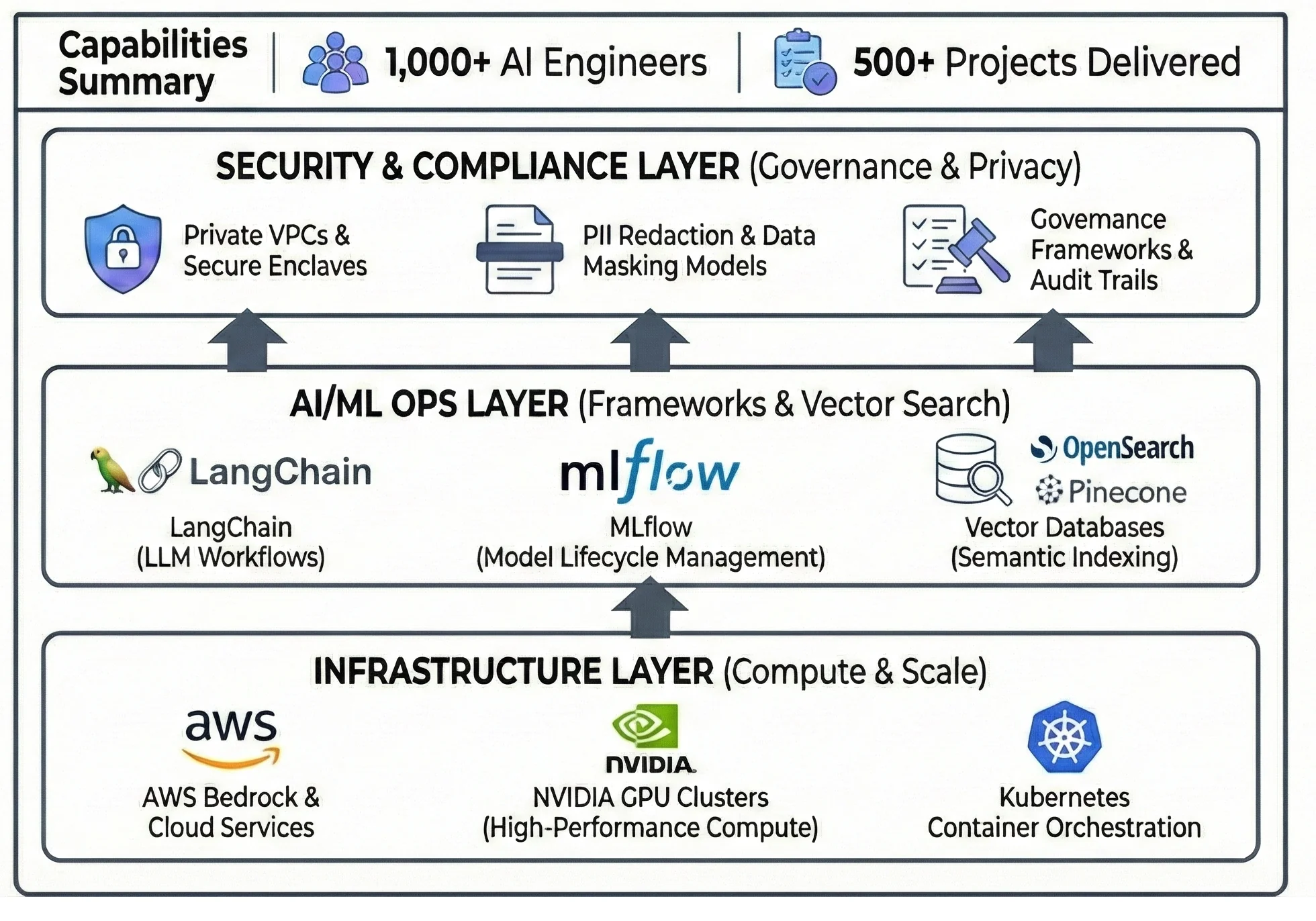
Explore Related Retail Supply Chain Automation Solutions



Custom AI Inventory Management Frequently Asked Questions
Why should a retail chain build a custom inventory management system instead of buying SaaS?
Custom AI inventory management solutions offer the flexibility to integrate with unique legacy POS systems and proprietary data pipelines that off-the-shelf SaaS cannot handle. By building a bespoke system, retailers avoid high per-location licensing fees and can tailor forecasting algorithms to their specific market dynamics, ensuring the system scales alongside the business without performance degradation.
How do predictive demand forecasting models improve retail operations?
Predictive demand forecasting models allow retailers to shift from reactive restocking to proactive planning by analyzing seasonality, local trends, and promotions. Unlike simple historical averages, these machine learning models forecast demand at the individual store level, which has been proven to reduce stock-out rates from 18% to under 5% in high-volume environments.
How does ViHealthBERT improve semantic search for pharmacy e-commerce?
ViHealthBERT is a domain-specific language model fine-tuned for health and retail intent that understands medical synonyms, slang, and common misspellings. By replacing traditional keyword-based search with this AI-driven approach, digital platforms can virtually eliminate “null result” pages and drive significant conversion growth.
What is the role of retail data engineering services in AI implementation?
Retail data engineering services provide the essential foundation for AI by cleaning, normalizing, and pipelining data from disparate POS and warehouse systems in real-time . Before any predictive model can function, these robust data infrastructures ensure that the AI is fed accurate, up-to-the-minute information, transforming “siloed data” into a unified “Customer DNA” profile.
How does semantic search increase e-commerce conversion rates?
AI semantic search increases e-commerce conversion rates by using vector embeddings to understand the true intent behind a user’s query rather than just matching keywords. This allows the system to correctly match ambiguous terms (e.g., “painkiller” to “Tylenol”), delivering contextually relevant results 95% of the time and preventing the customer churn associated with “No Results” pages.
How can retail supply chain automation scale to support thousands of locations?
Successful AI-driven supply chain modernization scales through cloud-native, microservices-based architectures and high-speed vector databases like Milvus. By processing intent at the edge and utilizing scalable search engines like Elasticsearch, these systems can handle millions of SKUs and concurrent queries across a nationwide network without latency or performance loss.