
 In the rapidly evolving landscape of access control, traditional physical keys and fragmented proprietary mobile solutions are increasingly seen as roadblocks to innovation and user convenience. As standard digital formats modernize other industries (e.g., payments via EMV/NFC), the market demand for secure, universal digital keys for buildings and devices is intensifying.
For those individuals overseeing access control systems, security products, or smart building technology, understanding the emerging landscape of standardization is critical.
Enter Aliro: the unifying digital key standard driving interoperability for access control akin to what Bluetooth did for peripheral connectivity.
Contents
What is Aliro?
Named after the Esperanto word for “access” (pronounced uh-LEER-oh), Aliro is a standardized communication protocol and credential standard that enables seamless, secure digital key experiences across different lock and user device manufacturers.
It is developed under the auspices of the Connectivity Standards Alliance (CSA), the same influential body behind the Matter smart home standard. While Matter focuses on device control in the smart home, Aliro is specifically focused on the user experience (UX) and protocol standardization for access (entering doors, gates, units) in residential and commercial settings.
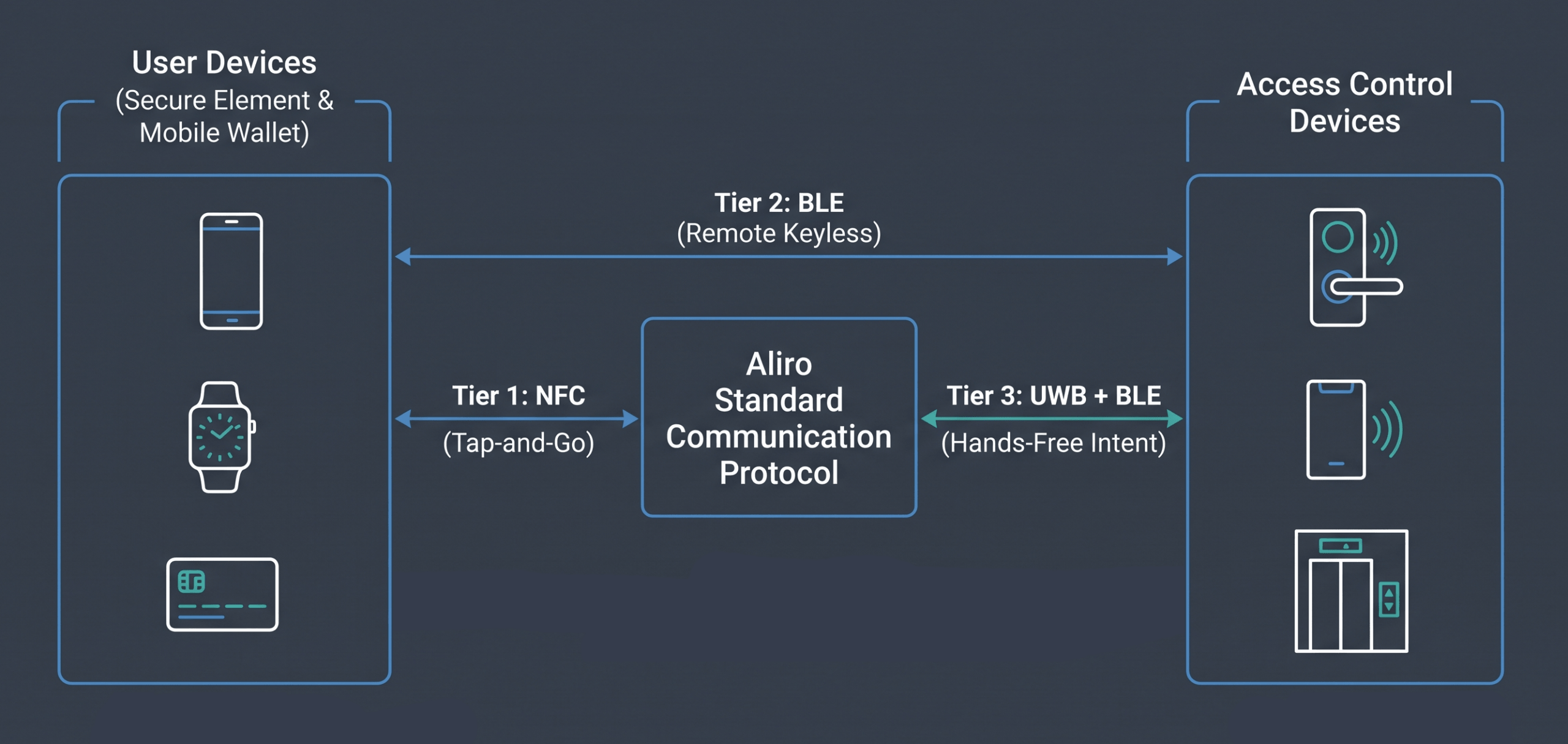
Aliro is not a consumer app or a specific product. It is the underlying language and security structure that allows a smartphone or wearable (iOS, Android) in a user’s wallet to communicate interoperably with any Aliro-certified access control device (smart lock, card reader, elevator panel).
Aliro defines two primary components:
- Aliro Credential Standard: Specifies the cryptographic data structures, X.509 certificates, and security architecture required to store a digital key securely within a user device’s secure element (SE), mobile wallet, or smart card.
- Aliro Communication Protocol: Standardizes the language spoken between the user device and the access control device over existing wireless technologies (NFC, BLE, and UWB) to exchange credentials and execute authentication handshakes.
Aliro Access Control Standard Ecosystem Architecture
Why Is the Market Demanding Aliro?
Currently, the digital access ecosystem is fragmented by proprietary systems, causing significant friction for users, manufacturers, and enterprise managers. Aliro addresses these core pain points.
1. Eliminating Proprietary Vendor Lock-in (Consumer Pain Point)
Currently, a user device might support one type of digital lock, while another requires a different mobile wallet or a manufacturer-specific app. This creates a “hodgepodge” of apps and conflicting digital wallet ecosystems for the consumer.
Aliro, as an open, cross-platform standard, ensures that a user can maintain a single digital credential that works across residential, commercial, and hospitality settings, regardless of the smartphone or lock hardware manufacturer. It empowers the consumer to utilize the mobile wallet of their choice.
2. Streamlining R&D Costs and Testing Burden (Manufacturer Pain Point)
Today, manufacturers of access control devices (locks, readers) must build and maintain distinct software integrations for every major mobile operating system and mobile wallet provider. This resource-intensive duplication of effort increases R&D costs and significantly adds to the testing and compliance burden.
By building to the Aliro specification, manufacturers can leverage a single standardization layer and gain broad compatibility across all major smartphone platforms and wallets. Cardinal Peak’s connected device engineering services can handle this complex standardization layer, freeing up your internal engineering team to focus strictly on core hardware and differentiating features.
3. Reducing Enterprise Complexity (Access Management Pain Point)
Facility managers (offices, hospitality, multi-dwelling units) often manage distinct access systems for building entry, elevator access, parking garages, and individual unit access. Integrating these proprietary systems to provide a unified user experience is a major complexity.
Aliro provides a single, scalable credential model. A sole digital key on a user’s device can grant seamless access across disparate access points and environments, simplifying management and improving user throughput.
Tiers of Aliro Support: A Modular Adoption Path
The Aliro Communication protocol is categorized into three sequential, performance-based levels called “Tiers.” These tiers allow manufacturers to choose the level of hardware support that matches their product’s required user experience and power constraints.
- Tier 1: Tap to Access (NFC Mandatory). This tier is mandatory for all Aliro-certified hardware. It implements the familiar “tap-and-go” functionality.
- Mechanism: ISO7816 APDU card emulation over NFC (0–4cm range).
- Benefit: Applies to key cards and smartphones/wearables with NFC. Notably, it serves as an emergency backup, often functioning even if the smartphone battery has died.
- Tier 2: Remote Keyless Entry (BLE Optional). Enables remote, user-initiated interaction at a distance.
- Mechanism: BLE (30–50 meters). Requires a specific user action (e.g., button press in app or on capacitive element).
- Tier 3: Hands-Free Proximity (BLE + UWB Optional). This is the high-performance tier enabling a true “walk-up” unlock experience, where the lock opens automatically as the user approaches.
- Mechanism: Uses BLE for initial discovery and communication, paired with Ultra-Wideband (UWB) Channel 9 for high-accuracy, spatial intent analysis.
- Range: 0–30 meters, with access granted only when the user device enters the “Intent Zone” (usually <1 meter and approaching).
Behind the Handshake: The Transaction Lifecycle
A common question is: “How fast is this in reality?” The target for standard transaction speed is well under 500 milliseconds (fast path).
To achieve this while maintaining rigorous security, the Aliro protocol executes a structured transactional lifecycle across all three tiers:
- Discovery and Link Establishment: The devices find each other.
- NFC (Tier 1): Access device (powered) polls for user devices and establishes ISO-DEP transport.
- BLE (Tier 2/3): User device advertises the Aliro Service UUID; access device connects via BLE.
- Application Select: The access device sends a cleartext ISO7816-4 APDU SELECT command containing the Aliro AID (Application ID) to the user device. The user device activates the correct Aliro applet and returns crucial capability data (version, supported tiers/transaction types, power state).
- Authentication Phase (Key Exchange & Identity Proof): This is critical.
- Goal: Mutual Authentication with Session Security (encrypted, immune to relay attacks) and No Shared Secrets (Public Key Infrastructure/Asymmetric crypto only).
- Devices perform Ephemeral Key Exchange (ECDHSA) to establish transient shared session secrets. Both sides prove identity using pre-provisioned asymmetric keys and digital certificates (signed cryptograms).
- Paths: Expedited-Standard (full mutual authentication, mandatory for first-time use) and Expedited-Fast (uses cached context for rapid re-authentication, reducing latency significantly).
- Decision Phase: The access device verifies the authenticated credentials against local access control rules (identifier verification, schedules, zones/groups).
- UWB Intent (Tier 3): In hands-free scenarios, the decision phase incorporates spatial awareness—measuring Intent Zone (user proximity) and Trajectory (verifying approach rather than a user walking past the door).
- Execution: If granted, the physical lock is activated, user feedback (visual/audio) is provided, and the transaction is logged.
- Session Teardown: Resources are cleared.
Aliro Protocol Transaction Lifecycle & Fast-Path Authentication

Implementation Challenges: Security, Power, and Precision
There are several key challenges to navigate during Aliro implementation, primarily focused on Security Lifecycle Management and Ultra-Wideband (UWB) Performance.
1. The Secure Element Mandate
For Aliro, cryptographic private keys and access certificates cannot be stored in standard flash memory, where they could be extracted or altered. They must reside inside a tamper-proof Secure Element (SE) or dedicated Hardware Security Module (HSM).
- Engineering Impact: Hardware roadmaps must account for microcontrollers with integrated SEs or the addition of discrete SE components.
2. Cryptographic Compute Constraints
Executing asynchronous cryptographic signature checks entirely in software causes unacceptable UX latency and places a high compute load on battery-operated devices. To maintain transaction time targets, specialized hardware crypto accelerators are essential.
- Engineering Impact: Your design must incorporate efficient asynchronous compute, often relying on hardware accelerators, while balancing the power-hungry nature of constant signature generation.
3. UWB Antenna Tuning and Directionality
Implementing Tier 3 (Hands-Free) is technically complex. UWB time-of-flight pulses are critical not just for distance but for analyzing direction and approach trajectory.
These high-frequency pulses are affected by temperature, humidity, interference, and the media the reader is embedded in (wood, metal, high-insulation glass).
- Engineering Impact: Achieving reliable “Intent Zone” detection requires significant investment in UWB antenna tuning—both placement optimization and environmental/media correction—to ensure precise performance in real-world environments.
4. Power Optimization vs. UWB Transceiver
While BLE is low-power, UWB transceivers consume significant energy. Balancing the need for rapid wake-up/discovery (low latency) against the required battery life for residential or commercial locks is a major engineering tradeoff.
- Engineering Impact: Engineers must optimize the handshake sequence, leveraging BLE and ephemeral IDs efficiently to keep the UWB transceiver active only as long as necessary for the spatial checks.
Future Outlook and Ecosystem Evolution
The Aliro standard continues to evolve, with critical future work focused on enterprise adoption and enhanced user collaboration:
- Standardized Secure Key Sharing (P2P): Establishing standard protocols for delegation, allowing an iOS user to easily share a temporary digital key with an Android user.
- Enterprise-Level Support: Expanding the protocol for multi-door/multi-zone credential trees and specialized access points (elevators, turnstiles, parking gates).
- Server-Based/Cloud Provisioning: Developing asynchronous credential delivery models suitable for offline devices in large-scale deployments.
- Ecosystem Harmony (Matter Coordination): Coordinating with Matter to allow a successful access control event (e.g., unlocking the front door) to trigger broader smart building or home automation routines.
Preparing Your Product Roadmap for the Aliro Access Control Standard
Aliro represents a fundamental progression from proprietary, fragmented systems to a secure, interoperable ecosystem for digital access control. For technology leaders in this space, ignoring the emergence of the CSA Aliro standard introduces the risk of vendor lock-in, resource-intensive maintenance of duplicated integrations, and product stagnation.
While implementation—particularly securing cryptographic keys in hardware SEs and tuning high-performance UWB systems—introduces non-trivial engineering challenges, the reward is an accessible, single credential model that reduces complexity and creates the seamless, cross-platform experience that today’s users demand.
Now is the time to assess your hardware and software roadmaps for Aliro compatibility, ensuring your products are ready for the open era of access control.
As a proud member of the Connectivity Standards Alliance (CSA), Cardinal Peak understands the specific intricacies of these evolving specifications. Navigating the cryptographic, hardware, and UWB tuning requirements of the Aliro standard requires specialized expertise. Contact us to discuss how our end-to-end engineering services can own this technical burden, accelerate your product roadmap, and ensure your next-generation access control devices are compliant, secure, and market-ready.