
 Most software product post-mortems share a common, frustrating baseline: the application functions flawlessly at the code level, yet users struggle to complete core workflows. Issues like a fractured onboarding experience, feature bloat, or a high-friction checkout loop are rarely isolated bugs. As detailed in our comprehensive industry analysis published on UX Matters, these friction points are systematic patterns that erode product adoption, drain engineering throughput, and degrade customer lifetime value.
Design debt compounds quietly beneath the surface of active backlogs. Left unaddressed, it creates a drag on development speed, inflates customer support queues, and distances the product from true market alignment. Executing an objective UX audit process acts as an architectural risk assessment, identifying user interface liabilities before they require emergency backend engineering remediation.
Contents
Design Debt and the Impact on Engineering Throughput
When product development teams are forced into aggressive release cycles, critical user experience flaws frequently remain unaddressed in production code. Over time, features deployed without quantitative validation generate significant maintenance overhead that compromises every subsequent sprint.
Hidden interface bottlenecks—such as non-standard navigation patterns or complex form validations—do more than frustrate users. They create downstream technical debt, generating high volumes of support tickets, design rework requests, and telemetry drop-offs.
The structural result is a predictable operational bottleneck:
- Sprint velocity drops as development teams spend an increasing percentage of each cycle patching usability issues rather than shipping new core functionality.
- Engineering hours are systematically diverted into untangling legacy workflows instead of building the next high-value, revenue-generating feature.
- For companies managing limited budgets or tight launch windows, this misallocation of technical resources directly compromises product time-to-market.
The Three-Phase UX Audit Framework
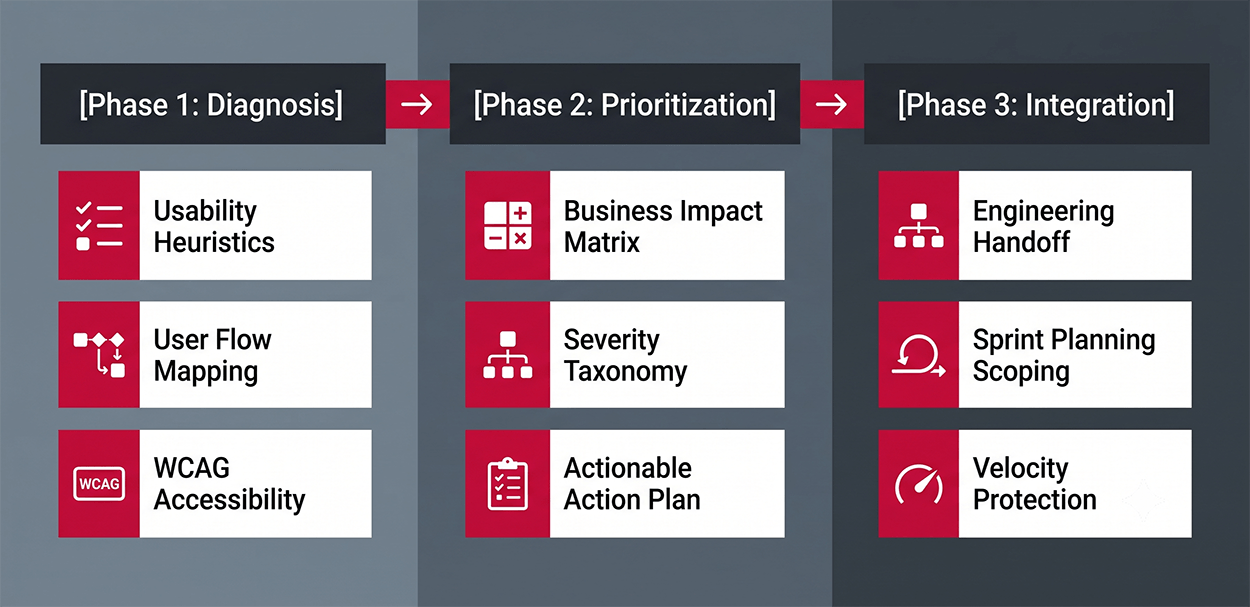
To transform subjective usability observations into concrete, actionable engineering tasks, an objective UX audit framework must follow a disciplined, three-phase process:
1. Diagnosis
The audit begins with an empirical evaluation of the software application against established usability heuristics, accessibility mandates, and behavioral data. This phase includes a rigorous information architecture review, user journey flow mapping, and cross-platform accessibility testing to ensure compliance with WCAG standards. Rather than relying on assumptions, Cardinal Peak analyzes software down to the component level, identifying structural blind spots that teams inside the daily development loop are often too close to see.
2. Prioritization
Uncovered issues are organized into a strict severity matrix based on their direct business impact and the technical effort required to resolve them:
- Critical Priority: Must-fix structural failures that block core application paths, present compliance or security risks, or cause immediate user abandonment.
- High Priority: Major usability barriers that cause significant user friction, lowering conversion rates or driving down retention metrics.
- Optimization Support: Minor visual inconsistencies or enhancement opportunities that refine long-term platform consistency and user satisfaction.
This taxonomy ensures engineering leadership receives a sequenced, strategic remediation plan rather than an unmanageable list of visual edits.
3. Integration
The final phase involves a structured engineering handoff and roadmap consultation. Rather than disrupting a team’s current production cycle, fixes are translated into clear, granular requirements detailing the observed issue, severity, technical origin, user impact, and the precise remedy. This format allows product managers to seamlessly inject remediations into upcoming sprint planning sessions, respecting fixed sprint capacities and protecting existing team velocity.
Aligning Usability Metrics with Engineering Outcomes
A systematic UX review acts as a predictive risk management tool that directly influences core business and operational metrics:
- Reduced Customer Acquisition Cost (CAC): Streamlining onboarding workflows prevents marketing spend from being squandered on users who abandon the application during initial setup.
- Protected Customer Lifetime Value (CLV): Eliminating friction points within transactional paths mitigates premature user churn and preserves customer loyalty.
- Improved Development Cycle Efficiency: Resolving foundational pattern flaws eliminates the repetitive, cyclical rework of fragile front-end code, allowing developers to build on a clean, validated visual architecture.
For product organizations preparing for market expansion, architectural upgrades, or institutional funding rounds, a professional audit serves as a critical verification signal: proof that the software ecosystem is engineered for scale on user-validated data rather than unverified assumptions.
Next Steps for Product Portfolios
Unaddressed interface liabilities represent an avoidable drag on your software performance and development capacity. To explore how these usability issues manifest across specific product ecosystems, read the complete foundational framework on UX Matters.
If you are ready to identify and eliminate design debt in your own application, explore Cardinal Peak’s specialized UX Audit Services and reach out to connect with our engineering and design teams today.