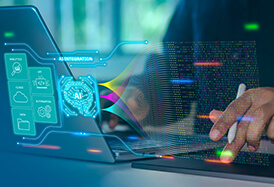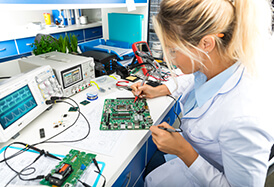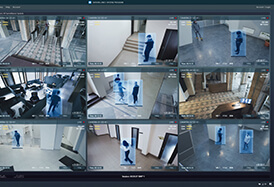

We help technical leaders define their desired outcomes and engineer the hardware, software, and data systems required to turn AI models into shipping products. Having developed connected devices and cloud infrastructure for over 20 years, Cardinal Peak understands that adding intelligence is not magic. It is an engineering challenge involving strict trade-offs between latency, power consumption, model accuracy, and operating costs.
To help navigate these constraints, our team provides end-to-end AI & data product engineering services. Whether a project involves quantizing a vision model to run on a battery-powered microcontroller or architecting a secure RAG pipeline for enterprise knowledge, we deliver the execution needed to move from a proof-of-concept to production through connected devices, desktop, and mobile applications.
To ensure reliable AI deployment, Cardinal Peak integrates embedded AI and computer vision with enterprise-scale data engineering and agentic AI. By owning this entire technical burden, we eliminate integration risks between different vendors and accelerate your product’s time-to-market.

In AI product development, speed and reliability are often at odds. To solve this, we leverage a global library of pre-built accelerators and strategic partnerships. These are battle-tested reference architectures and optimization frameworks that allow our engineers to bypass months of foundational coding.


We accelerate development by utilizing reference architectures for secure enterprise assistants. Instead of building a RAG pipeline from scratch, we utilize a modular framework that pre-integrates vector databases, LLM orchestration (LangChain/Bedrock), and critical security guardrails. This solves the “plumbing” problem—RBAC, data connectors, and hallucination checks—so we can focus on tuning the model for your specific domain data.
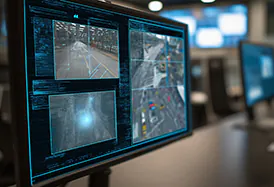
Our teams utilize pre-trained modules for automated defect detection. Leveraging the Intelligent Inspection (I2) framework, we deploy computer vision and acoustic anomaly detection systems faster. This framework includes pre-validated drivers for industrial cameras, lighting controls, and edge inference engines, reducing hardware integration complexity and allowing us to focus on your specific defect criteria.

We provide deep-bench access to world-class research because AI moves faster than any single team can track. As an FPT company, we have direct reach-back to Mila (Quebec AI Institute) for solving novel algorithmic challenges and Landing AI for specialized visual inspection tools. If we hit a mathematical wall, we have the researchers to help unblock an engineering team.
Our engineering teams deliver production-ready solutions across manufacturing, automotive, materials, and healthcare. Whether architecting scalable AWS data platforms for medical diagnostics or delivering industrial automation, these projects demonstrate the technical reality of our AI and data product engineering services. Explore all our AI case studies.

We provided end-to-end AI product development services for a vision-based workflow automation platform. By optimizing MLOps and data pipeline engineering services on AWS, we helped the client reduce processing costs by 99% while significantly enhancing procurement efficiency and system scalability.
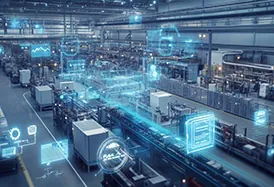
We engineered an embedded AI engineering solution to automate subjective motor inspections in high-noise (90dB) factory environments. Utilizing deep learning and advanced DSP for real-time feature extraction, the system achieved 95% defect detection accuracy and doubled inspection throughput within one month.
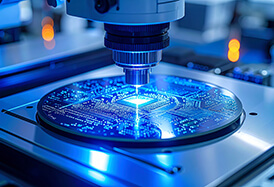
We engineered a custom computer vision and edge AI solution to automate microscopic semiconductor wafer inspection. By optimizing and quantizing deep learning models for deployment on constrained edge hardware, the system achieved 95% defect detection accuracy and sub-second inference latency while reducing inspection labor costs by 80%.
We provided end-to-end AI product development services for a vision-based workflow automation platform. By optimizing MLOps and data pipeline engineering services on AWS, we helped the client reduce processing costs by 99% while significantly enhancing procurement efficiency and system scalability.
We engineered an embedded AI engineering solution to automate subjective motor inspections in high-noise (90dB) factory environments. Utilizing deep learning and advanced DSP for real-time feature extraction, the system achieved 95% defect detection accuracy and doubled inspection throughput within one month.
We engineered a custom computer vision and edge AI solution to automate microscopic semiconductor wafer inspection. By optimizing and quantizing deep learning models for deployment on constrained edge hardware, the system achieved 95% defect detection accuracy and sub-second inference latency while reducing inspection labor costs by 80%.
Cardinal Peak is a highly capable US-based engineering team that scales globally. We provide onshore architectural leadership, core engineering execution, project management, and rapid prototyping to ensure your solution perfectly matches your requirements. For scale, we seamlessly integrate FPT’s global talent pool and deep AI bench, giving you the clear communication of a local partner and the execution power of a top-tier global firm.

To ensure your project has both localized architectural leadership and global execution power, we leverage a unified delivery model backed by one of the largest specialized AI benches in the world.
This ecosystem includes deep partnerships and certifications with the silicon vendors you use.
Deploying GenAI requires strict control over how AI agents respond to requests. We engineer the necessary technical guardrails—including hallucination checks, prompt injection defenses, and role-based access controls (RBAC)—directly into your architecture. We operate under ISO 42001-certified security frameworks to ensure your models behave predictably and your proprietary data remains entirely yours.




We apply our core AI engineering capabilities to solve specific challenges in your industry.
AI product engineering is the holistic process of designing, building, and deploying artificial intelligence as a complete physical or digital product, rather than just a theoretical model. Unlike traditional data science, which focuses on algorithm accuracy in a lab, AI product engineering encompasses the entire lifecycle: data pipeline infrastructure, hardware selection, edge optimization, cloud integration, and continuous MLOps monitoring to ensure the system performs reliably in the real world.
Enterprise security requires engineering custom GenAI solutions based on Retrieval-Augmented Generation (RAG) rather than relying on public APIs. This keeps your proprietary data within your own Virtual Private Cloud (VPC) or on-premise infrastructure. This ensures your sensitive documents are used only for context retrieval and are never exposed to the public internet or used to train public base models.
Yes, but it requires rigorous optimization through embedded AI engineering techniques like model quantization, channel pruning, and knowledge distillation. These processes reduce model size and latency, allowing complex inference engines to run efficiently on resource-constrained NPUs (like NXP or STMicro) within strict milliwatt power budgets.
The main difference is infrastructure and reliability; while a PoC proves a mathematical model works, production-ready AI requires robust MLOps and data pipelines to handle real-world scale. This includes automated pipelines for data cleaning, version control for models, and continuous monitoring systems to detect “model drift,” allowing you to update models over-the-air (OTA) as environmental conditions change.
Successful AI product development follows a disciplined lifecycle that bridges hardware and software:
Beyond the code, our team regularly documents the trade-offs and architectural decisions required for successful deployment in the real world. Explore all our AI blog posts.
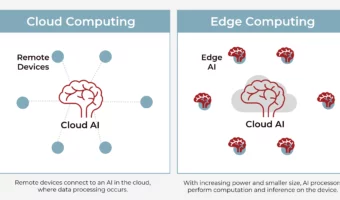
Selecting the right environment is foundational to Embedded AI Engineering Services. We break down the technical differences between on-device inference and cloud-based models to help you balance latency, power, and cost for production-ready intelligence.

Building Enterprise GenAI Development Services requires moving past basic prompts to complex data orchestration. This post explores the technical challenges of harnessing generative models for secure, production-grade database insights without compromising data privacy.

True End-to-End AI Product Development Services prioritize how users interact with complex intelligence. Discover how to manage the complexity of AI-driven interfaces to build intuitive, meaningful products that move the needle for your users.
Selecting the right environment is foundational to Embedded AI Engineering Services. We break down the technical differences between on-device inference and cloud-based models to help you balance latency, power, and cost for production-ready intelligence.
Building Enterprise GenAI Development Services requires moving past basic prompts to complex data orchestration. This post explores the technical challenges of harnessing generative models for secure, production-grade database insights without compromising data privacy.
True End-to-End AI Product Development Services prioritize how users interact with complex intelligence. Discover how to manage the complexity of AI-driven interfaces to build intuitive, meaningful products that move the needle for your users.