
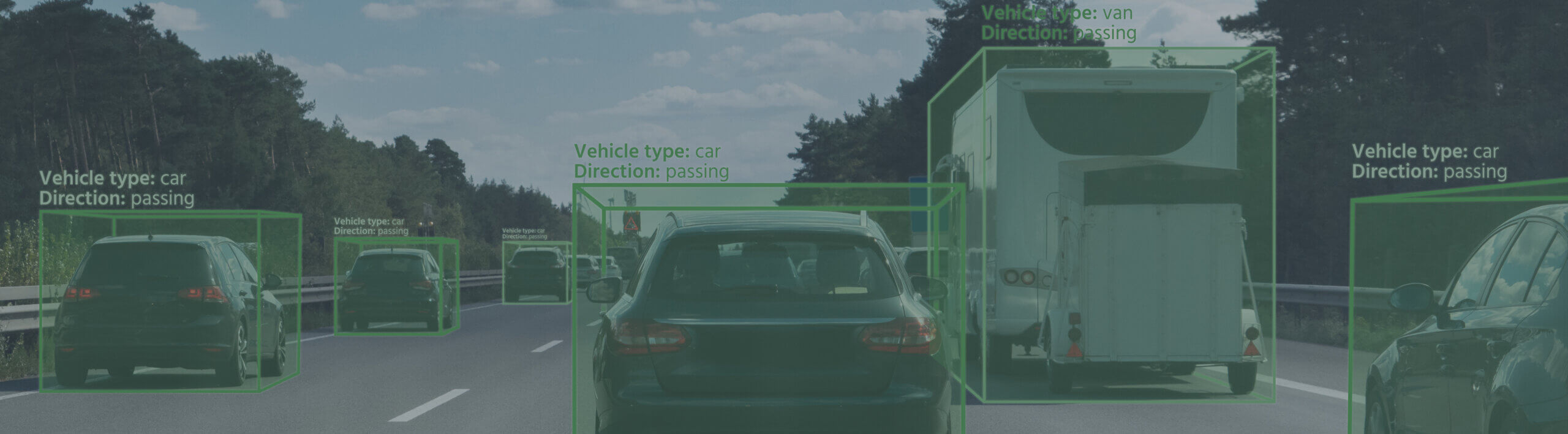
By transforming raw sensor data into deterministic, actionable intelligence, organizations unlock the ability to automate complex inspections, secure environments, and analyze behavior with unwavering reliability.
We engineer custom computer vision development services that deliver reliable, automated insights in your specific environment. We move beyond standard “object detection” to build high-precision algorithms that run locally on your hardware or scale in the cloud. Whether you need to inspect silicon wafers at high speed or analyze an athlete’s backhand in real-time, we optimize the entire pipeline—from the sensor driver to the inference engine—ensuring you own the IP and the intelligence.
We bridge the gap between theoretical AI models and ruggedized production systems, across the full spectrum of compute.
Speed and security often demand that processing happens on the device, not the cloud. We specialize in engineering models that run on resource-constrained chips.
We optimize model deployment across diverse GPU and NPU platforms using advanced compiler frameworks like TensorRT, OpenVINO, ExecuTorch, and ONNX Runtime.
We use techniques like INT8 quantization to deliver real-time frame rates without the latency or bandwidth costs of the cloud.
By using these techniques, we shrink complex cloud models into efficient edge artifacts without sacrificing critical accuracy.

A model is only as useful as the action it triggers in the physical world. We integrate vision logic deeply into your embedded system to control motors, gates, or alerts in real-time.
We write custom drivers to optimize exposure, white balance, and shutter speed for your specific lighting conditions before the image ever hits the AI.
We integrate LiDAR, Stereoscopic, and Time-of-Flight (ToF) sensors for precise spatial measurements and volumetric analysis.
Ultimately, we optimize the entire signal chain—from optical sensor tuning to the final mechanical actuation.

For applications that require scalable processing of high-resolution streams across multiple feeds, we build powerful software-based analytics platforms.
We combine image, video, text, and sensor data using Vision-Language Models (VLMs) for deeper scene understanding and highly complex behavior analysis.
We move beyond passive detection by engineering systems that enable AI to interpret visual events, make deterministic decisions, and trigger downstream enterprise workflows automatically.
We architect these scalable platforms to process high-resolution streams from multiple sources to identify complex behaviors.

We deploy vision systems that don’t just “see,” they analyze, measure, and act. View all our AI engineering case studies.

Inspecting silicon wafers for microscopic defects is traditionally slow and error-prone. We provided edge computer vision development services, optimizing 11 deep learning models to run directly on ARM-based manufacturing line hardware. This automated edge solution achieved 95% classification accuracy and under 1-second inspection latency, reducing QA labor costs by 80% while keeping proprietary data on-premise.

Standard rule-based vision systems fail on complex, reflective surfaces. To solve this for a top-tier automotive supplier, we engineered a custom deep learning-based inspection system. By designing the optical environment and deploying CNNs directly to edge compute on the production line, the automated solution achieved 98%+ detection accuracy for critical defects and reduced inspection time by 30%.
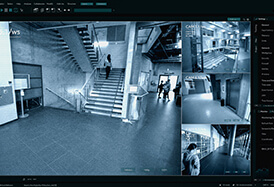
Tracking individuals across multiple, non-overlapping camera feeds without violating privacy regulations is a massive architectural challenge. We delivered AI video analytics development services to engineer a hybrid edge-cloud platform for a global telecommunications conglomerate. Utilizing custom Person Re-identification (Re-ID) models, the system seamlessly tracks individual trajectories across 20+ distributed enterprise locations, enhancing security coverage while reducing false alarms.
Inspecting silicon wafers for microscopic defects is traditionally slow and error-prone. We provided edge computer vision development services, optimizing 11 deep learning models to run directly on ARM-based manufacturing line hardware. This automated edge solution achieved 95% classification accuracy and under 1-second inspection latency, reducing QA labor costs by 80% while keeping proprietary data on-premise.
Standard rule-based vision systems fail on complex, reflective surfaces. To solve this for a top-tier automotive supplier, we engineered a custom deep learning-based inspection system. By designing the optical environment and deploying CNNs directly to edge compute on the production line, the automated solution achieved 98%+ detection accuracy for critical defects and reduced inspection time by 30%.
Tracking individuals across multiple, non-overlapping camera feeds without violating privacy regulations is a massive architectural challenge. We delivered AI video analytics development services to engineer a hybrid edge-cloud platform for a global telecommunications conglomerate. Utilizing custom Person Re-identification (Re-ID) models, the system seamlessly tracks individual trajectories across 20+ distributed enterprise locations, enhancing security coverage while reducing false alarms.
Building reliable computer vision systems requires a rigorous engineering process. We follow a disciplined lifecycle to transform raw sensor data into optimized, production-ready vision applications.
Reliable computer vision depends on capturing the highest quality optical data. We help select the right image sensors, lenses, and lighting, delivering a hardware selection report and optical setup verification.
We implement rigorous data labeling protocols and generate synthetic data to train models on rare events. We deliver a curated, balanced training dataset.
We utilize pre-trained vision foundation models to drastically reduce manual data labeling and accelerate domain adaptation. The result is a highly accurate model tuned specifically for your environment’s precision and recall targets.
We convert the model for your target hardware (e.g., converting PyTorch to TensorRT or TFLite) and validate that it meets thermal and timing constraints. We deliver a production-ready inference engine running at target FPS.
We optimize for the hardware and software that powers your industry.







Deploying custom computer vision models into the real world requires a robust underlying architecture. Explore our related engineering services that support end-to-end vision product development and video processing.
The decision balances latency constraints against required compute power. For near-instant, disconnected inference, we leverage edge computer vision development services to process on-device. For massive, multi-stream batch processing, we architect cloud-based AI video analytics development services.
Data requirements scale with task complexity, ranging from hundreds to tens of thousands of annotated images. As part of our custom computer vision development services, we utilize transfer learning and synthetic data generation to minimize manual annotation while ensuring high accuracy in varied environments.
Object detection draws bounding boxes, semantic segmentation categorizes every pixel, and instance segmentation identifies individual overlapping objects. We select the most computationally efficient method necessary to solve your specific engineering challenge without wasting edge compute resources.
Yes, but standard models will fail without deliberate optical and algorithmic engineering. Through our embedded vision engineering services, we augment training data, integrate specialized sensors (like IR or thermal), and select robust architectures designed specifically for noisy, occluded environments.
Real-time performance requires holistic optimization across the entire video and AI pipeline. We deliver low-latency analytics by engineering efficient GStreamer decoding pipelines, selecting hardware accelerators (GPUs/NPUs), and utilizing tools like TensorRT for maximum inference speed.
Explore our latest technical insights on building reliable, production-ready vision systems. Explore all AI engineering articles.
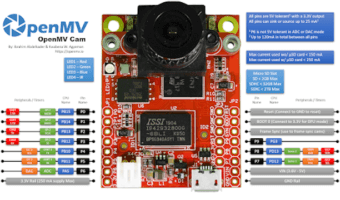
As autonomous systems proliferate, moving inference to the edge is critical. Discover the architectural steps and hardware considerations for building efficient, low-power embedded vision engineering services using tools like the OpenMV platform.

Discover how our AI video analytics development services helped a private investigation firm build a first-of-its-kind uncrewed surveillance camera. Listen to the client discuss how we integrated custom machine learning models at the edge to intelligently filter footage, reduce transmission costs, and streamline operations.
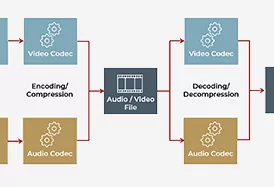
An AI model cannot analyze what a codec destroys. Delve into the technical trade-offs of various video encoding formats (H.264/H.265) and how to package media streams to feed custom computer vision development pipelines with minimal latency.
As autonomous systems proliferate, moving inference to the edge is critical. Discover the architectural steps and hardware considerations for building efficient, low-power embedded vision engineering services using tools like the OpenMV platform.
Discover how our AI video analytics development services helped a private investigation firm build a first-of-its-kind uncrewed surveillance camera. Listen to the client discuss how we integrated custom machine learning models at the edge to intelligently filter footage, reduce transmission costs, and streamline operations.
An AI model cannot analyze what a codec destroys. Delve into the technical trade-offs of various video encoding formats (H.264/H.265) and how to package media streams to feed custom computer vision development pipelines with minimal latency.