
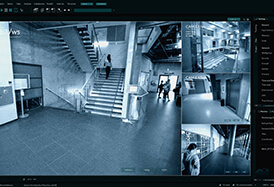
 A global telecommunications conglomerate needed to develop a scalable smart security platform for distributed enterprise facilities and large corporate campuses. The challenge was not just detecting people but maintaining a consistent “global identity” for individuals as they moved across vast, distributed networks of disconnected cameras. Standard facial recognition alone was insufficient for continuous tracking in complex, crowded environments.
They partnered with Cardinal Peak/FPT Software for large-scale AI video analytics engineering. We designed a sophisticated Hybrid Edge-Cloud Architecture that combines real-time recognition with advanced Person Re-identification (Re-ID) models. The resulting platform acts like a “digital air traffic control” for people, seamlessly tracking movement trajectories even when faces are obscured or turned away from the camera. The system is currently deployed successfully across more than 20 distributed corporate and industrial complexes.
The Challenge: The Limits of Face-Only Tracking
Standard video surveillance systems operate in silos; a person detected on Camera A is a completely new, unknown entity when they appear on Camera B five minutes later.
For a sprawling enterprise perimeter, the client found that relying solely on facial recognition for tracking was practically impossible. In many scenarios—people walking away from a camera, obscured by crowds, or at a distance—the face is not visible enough for a confident match, causing the system to lose the “track.” This fragmentation made it impossible to visualize movement patterns or secure large perimeters effectively.
The client required an engineered breakthrough that could:
- Track Without Faces: Maintain a persistent ID for an individual even when their face was not visible to the camera.
- Bridge the Gap: Connect identity across dozens of disconnected camera feeds.
- Scale Nationwide: Support massive data flows across many locations with centralized management.
Standard facial recognition is often insufficient in a sprawling, crowded facility. Real security engineering happens when you can maintain a persistent ‘global identity’ for individuals across a distributed network of disconnected cameras, even when their faces are never visible.
The Engineering Solution: A Hybrid AI Architecture
We developed a Custom Video Analytics Platform that combines immediate edge processing with centralized cloud intelligence to solve the cross-camera tracking challenge.
Hybrid Edge-Cloud Processing
To manage bandwidth and latency across a large, distributed perimeter, we split the AI workload.
- At the Edge: Cameras and local gateways handle immediate tasks like initial detection and feature extraction in real-time.
- In the Cloud (CMS): The Central Management System handles the heavy lifting of cross-referencing identities, storing global IDs, and visualizing data on facility maps.
The Core Technical Achievement: Person Re-identification (Re-ID)
This is the core engineering achievement designed to overcome the limits of face recognition. We developed and deployed custom AI models specifically for Person Re-identification. Re-ID analyzes the entire appearance of a person (clothing, gait, body shape) to recognize them as the same entity even when viewed from different angles, in poor lighting, or from behind.
Next-Gen Tracking with Vision Transformers
Moving beyond traditional Convolutional Neural Networks (CNNs), we utilized proprietary assets based on the latest Vision Transformer Models for robust multiple-object tracking. This allows the system to accurately follow many individuals simultaneously in crowded environments.
Distributed Hybrid AI Tracking Architecture
Custom hybrid AI architecture illustrating real-time feature extraction on edge gateways to minimize uplink bandwidth while centralized CMS handles cross-camera Re-ID and global ID persistence.

The Results: Nationwide Deployment at Scale
The custom video analytics platform successfully transformed fragmented video feeds into a unified, intelligent security grid.
- Enterprise Scale: Successfully deployed to over 20 large-scale corporate offices and distributed enterprise facilities.
- Real-Time Trajectory Mapping: Security personnel can now visualize the historical and current path of individuals on a digital facility map.
- Unified Global IDs: Solved the persistent tracking challenge, allowing for seamless monitoring across distributed camera networks.
The Engine Behind the Solution
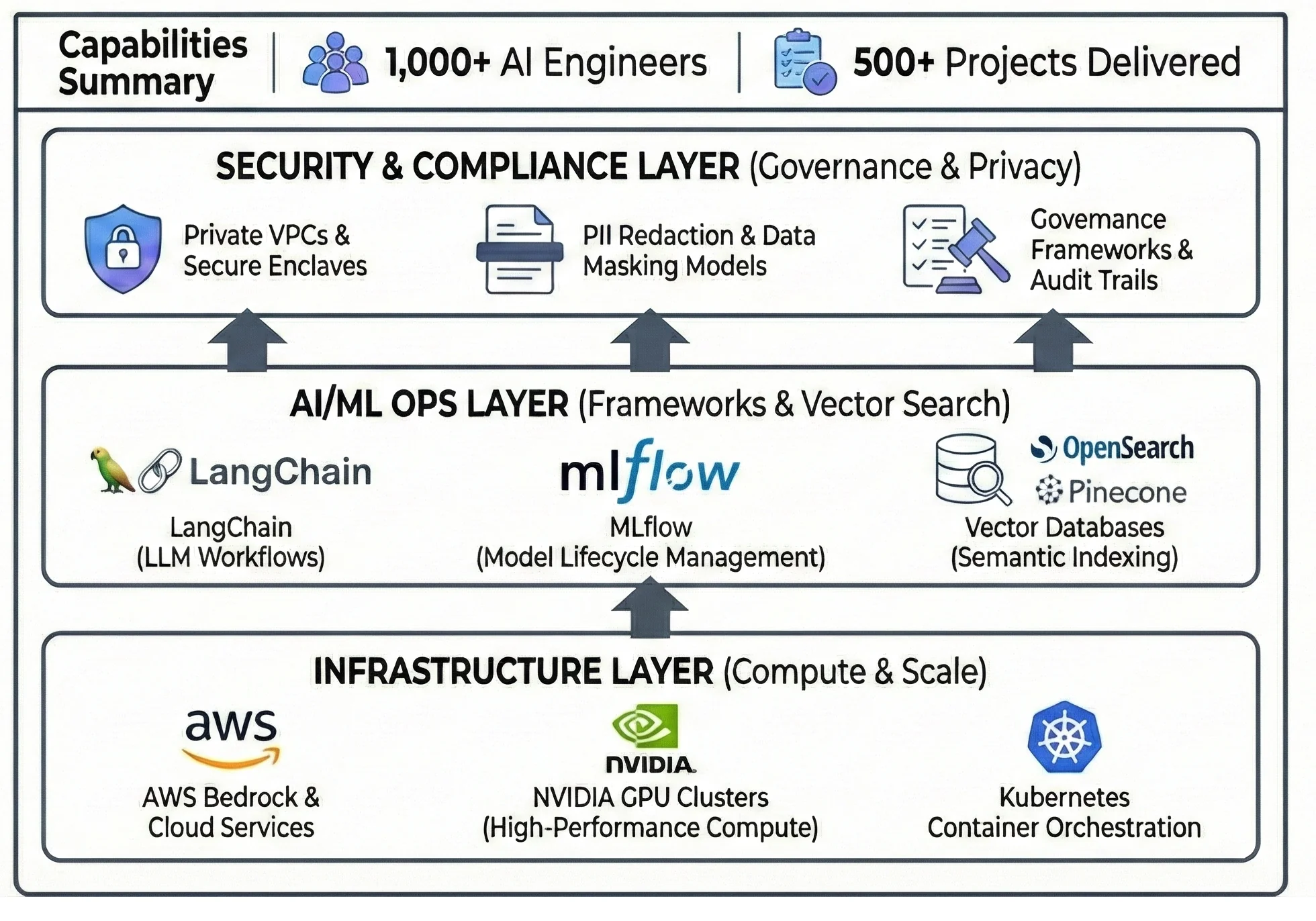
This project was executed by utilizing our expertise in Computer Vision, Cloud Architecture, and Edge AI. Our ability to engineer complex systems that balance edge latency with cloud scalability makes us the ideal partner for large-scale deployments.
Our AI CoE Capabilities
Explore Related Computer Vision & Edge AI Solutions


Large-Scale AI Video Analytics Engineering FAQs
What is Person Re-identification (Re-ID) in large-scale computer vision?
Person Re-identification (Re-ID) is an advanced computer vision technique used to identify and track an individual across non-overlapping camera views. Unlike facial recognition which requires a clear view of the face, Re-ID analyzes a person’s entire visual appearance—including clothing patterns, body shape, and gait—to maintain a unique global identity even when the face is obscured or at a distance.
Why use a hybrid edge-cloud architecture for distributed security solutions?
A hybrid edge-cloud vision architecture is essential to balance performance and bandwidth costs. By performing initial AI processing (like feature extraction) on local edge gateways, organizations reduce expensive uplink bandwidth and achieve ultra-low latency for on-site security. The cloud management system (CMS) then handles centralized cross-referencing of identities, trajectory mapping across the facility layout, and long-term data storage.
How do Vision Transformers improve multi-object tracking in crowded environments?
Vision Transformer models are increasingly preferred over traditional Convolutional Neural Networks (CNNs) for complex tracking in crowded environments. Because Vision Transformers analyze the global context of an image rather than just local features, they offer superior performance in distinguishing between individuals in dense crowds and maintaining accurate tracks over time in busy spaces like enterprise campuses, industrial sites, or transportation hubs.
What are the challenges of large-scale AI video analytics engineering?
Engineering large-scale AI video analytics across distributed locations requires overcoming significant challenges in bandwidth limitations, latency, and fragmented data silos. A successful approach typically involves deploying intelligent edge processors to handle raw video locally, connected to a centralized cloud platform capable of managing global identities and visualizing data across hundreds of disconnected camera feeds.
Can AI video analytics be integrated with existing legacy CCTV networks?
Yes. Modern large-scale AI video analytics engineering often utilizes intelligent edge gateways to modernize legacy infrastructure. These devices connect to existing CCTV cameras, adding AI processing capabilities to standard video streams before transmitting metadata to a central cloud platform, avoiding a complete hardware overhaul.
What is the benefit of trajectory mapping in a distributed security platform?
Trajectory mapping acts like “digital air traffic control,” allowing security personnel to visualize the historical and current movement paths of individuals directly on a digital facility map. This provides actionable real-time location data and allows for more effective perimeter security and crowd management across distributed camera networks.