

Your organization possesses decades of valuable institutional knowledge, but it is often locked in formats designed for humans—complex PDFs, technical diagrams, siloed databases, and real-time sensor logs—that modern analytics tools cannot access.
We provide data engineering services for AI that bridge the gap between this valuable, diverse data and production-grade models. We move beyond traditional ETL to build intelligent systems that unlock your proprietary Intellectual Property (IP). By engineering pipelines that handle unstructured data, automate semantic vectorization for Retrieval-Augmented Generation (RAG), and enforce strict lineage, we ensure your models are grounded in truth. Because we build these pipelines entirely within your secure infrastructure, your data remains strictly under your control.
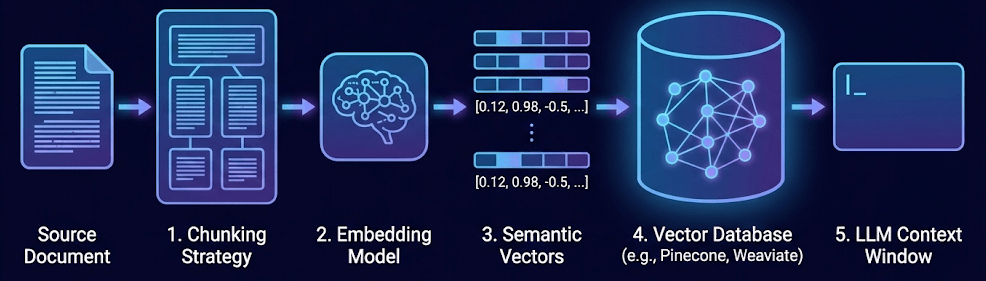
Unstructured human formats—such as PDFs, Excel sheets, scanned images, and audio waveforms—must be transformed before an AI can use them. We build the intelligent infrastructure that ingests these formats, processes them through an AI data pipeline featuring OCR extraction and normalization, and outputs a machine-ready vector array.

Valuable enterprise IP rarely lives in neat rows and columns. We specialize in RAG pipeline development services, engineering the complex workflows required to extract meaning from non-standard sources—parsing R&D documents with OCR, extracting tables from PDFs, and processing high-velocity IoT sensor logs. We handle the “last mile” of data access, building the deterministic data foundations that allow AI agents to move beyond passive knowledge retrieval. By structuring this data securely, our agentic AI data pipeline development services enable tool-using agents to confidently take actions, automate complex workflows, and interact directly with your business systems.
To power modern autonomous applications, data must be translated into semantic vectors. Our vector database implementation services cover the entire embedding pipeline. We intelligently chunk text based on context, pass it through specialized embedding models, and index it efficiently in vector stores (like Pinecone or Weaviate). This infrastructure serves as the long-term memory for your AI agents, allowing them to securely retain context, learn from past interactions, and deliver highly personalized, multi-turn support across enterprise applications.
Complex enterprise operations require specialized AI agents working in concert. We provide DataOps engineering services to architect unified data ecosystems that allow multiple agents—such as a research agent, an operations planner, and a customer service copilot—to securely share memory and collaborate. By enforcing strict data lineage, automated PII redaction, and schema validation gates, we ensure all agents operate from a single, ground-truth data reality, allowing you to trace any automated action back to its exact source document.
Enterprise AI relies on accurate, well-structured data. We architect the robust pipelines and vector databases that turn your proprietary knowledge into measurable business outcomes. View all our AI engineering case studies.

Scaling a nationwide retail network requires transforming fragmented data silos into a unified, real-time demand-forecasting engine. We engineered a data ecosystem that channels real-time inventory signals across 1,000+ distributed POS endpoints, integrating a specialized vector database (Milvus) to power a high-accuracy semantic search architecture. This custom pipeline engineering eliminated inventory mismatches, dropping stock-out rates from 18% to under 5% while driving a 2.5x increase in online revenue.

Processing terabytes of high-resolution single-cell imagery requires high-throughput data engineering to bypass on-premise hardware bottlenecks. We architected a cloud-native data pipeline that streams massive datasets directly from laboratory microscopy instruments into automated, event-driven pre-processing workflows. This scalable cloud infrastructure directly feeds parallel GPU compute clusters for real-time inference, removing latency and increasing image processing throughput by 10x.

Off-the-shelf models struggle with complex, multi-modal workflows without a highly optimized data ingestion layer. We provided DataOps engineering services for WorkDone to architect a secure, AWS-powered data pipeline that seamlessly routes heavy video processing streams into GenAI reasoning engines. This automated data orchestration helped the client cut processing costs by 99%, scale seamlessly, and significantly enhance procurement efficiency.
Scaling a nationwide retail network requires transforming fragmented data silos into a unified, real-time demand-forecasting engine. We engineered a data ecosystem that channels real-time inventory signals across 1,000+ distributed POS endpoints, integrating a specialized vector database (Milvus) to power a high-accuracy semantic search architecture. This custom pipeline engineering eliminated inventory mismatches, dropping stock-out rates from 18% to under 5% while driving a 2.5x increase in online revenue.
Processing terabytes of high-resolution single-cell imagery requires high-throughput data engineering to bypass on-premise hardware bottlenecks. We architected a cloud-native data pipeline that streams massive datasets directly from laboratory microscopy instruments into automated, event-driven pre-processing workflows. This scalable cloud infrastructure directly feeds parallel GPU compute clusters for real-time inference, removing latency and increasing image processing throughput by 10x.
Off-the-shelf models struggle with complex, multi-modal workflows without a highly optimized data ingestion layer. We provided DataOps engineering services for WorkDone to architect a secure, AWS-powered data pipeline that seamlessly routes heavy video processing streams into GenAI reasoning engines. This automated data orchestration helped the client cut processing costs by 99%, scale seamlessly, and significantly enhance procurement efficiency.
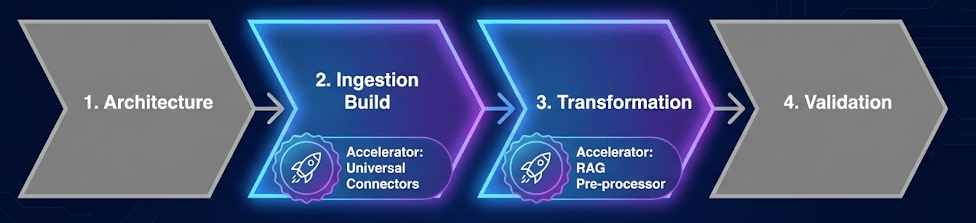
Building reliable data infrastructure demands a rigorous engineering approach. To accelerate delivery and reduce development costs, we leverage proven modules from our AI Accelerators—including pre-built ingestion frameworks for RAG document processing and high-velocity IoT streams. This allows us to jumpstart the initial setup and focus our engineering hours on solving the unique complexities of your specific data topology.
Identifying where your valuable IP resides and defining the target AI use case. By analyzing your unique data volume and velocity, we deliver a detailed data flow architecture and schema design.
Developing the custom connectors and parsers required to unlock your specific data formats. Using our accelerator modules for unstructured text and sensor logs, we deliver functional connectors that reliably extract raw data from your source systems.
Engineering the transformation logic, including context-aware text chunking and the integration of embedding models. The result is a production-ready pipeline that transforms raw text into semantic, AI-ready embeddings.
Implementing automated testing for data quality, PII redaction, and schema validation. This provides you with a hardened pipeline featuring automated quality checks, ensuring only clean, compliant data enters your AI serving layer.
We build with modern, scalable tools designed for the AI era.


Data engineering is the foundation, but deploying production AI requires full-stack capabilities. Explore our related engineering services.
The primary bottleneck is almost always data readiness, which is why organizations rely on professional data engineering services for AI. While companies have vast amounts of data, it is usually siloed or unstructured. The majority of AI project effort involves building robust pipelines to extract, transform, and deliver this data.
We utilize RAG pipeline development services to ingest, chunk, and embed unstructured documents into machine-readable semantic vectors. This automated workflow allows your AI models to securely query proprietary PDFs, research papers, and databases without needing to retrain the underlying foundational model.
Relational databases match exact keywords, whereas our vector database implementation services enable semantic search by comparing mathematical representations of concepts. This allows AI agents to retrieve highly relevant context based on underlying meaning and intent, which is required for accurate AI reasoning.
We deploy comprehensive DataOps engineering services to implement automated PII redaction, schema validation gates, and strict lineage tracking. In regulated industries, this foundational infrastructure is critical to ensure you can always trace an AI output back to its exact, unmodified source document.
The modern standard for cloud-based AI infrastructure is ELT, which we implement as part of our data engineering services for AI. By loading raw data into the data lake first and transforming it later via cloud compute, you preserve the original datasets for future, unforeseen machine learning use cases.
Explore our latest technical insights on architecting scalable pipelines, implementing vector search, and preparing enterprise data for machine learning. Explore all AI engineering articles.
Extracting actionable intelligence from massive, unstructured text datasets requires rigorous data engineering. Discover how we utilized DataOps engineering services and Amazon SageMaker to architect a scalable cloud pipeline capable of ingesting, cleaning, and analyzing millions of social media posts for real-time sentiment modeling.

Integrating LLMs with proprietary databases requires robust RAG pipeline development services and secure data orchestration. Discover the technical trade-offs, vector database architecture choices, and governance guardrails necessary to safely harness generative models for production-grade data analysis.

Extracting value from high-velocity sensor data requires specialized data engineering services for AI. Learn how the convergence of Digital Signal Processing (DSP) and Machine Learning allows us to clean, filter, and structure complex edge data for predictive modeling and anomaly detection.
Extracting actionable intelligence from massive, unstructured text datasets requires rigorous data engineering. Discover how we utilized DataOps engineering services and Amazon SageMaker to architect a scalable cloud pipeline capable of ingesting, cleaning, and analyzing millions of social media posts for real-time sentiment modeling.
Integrating LLMs with proprietary databases requires robust RAG pipeline development services and secure data orchestration. Discover the technical trade-offs, vector database architecture choices, and governance guardrails necessary to safely harness generative models for production-grade data analysis.
Extracting value from high-velocity sensor data requires specialized data engineering services for AI. Learn how the convergence of Digital Signal Processing (DSP) and Machine Learning allows us to clean, filter, and structure complex edge data for predictive modeling and anomaly detection.